In industrial organization, the minimum efficient scale (MES) or efficient scale of production is the lowest point where the plant (or firm) can produce such that its long run average costs are minimized.
- Carlton D. And Perloff Modern Industrial Organization Fourth Edition 2005 Edition
- Carlton D. And Perloff Modern Industrial Organization Fourth Edition 2005 Download
Dennis Carlton and Jeffrey Perloff, Modern Industrial Organization (4th Edition), 2004. Used at some big-10 schools, but less modern than I'd like, and does too little with too many topics. Stephen Martin, Industrial Organization in Context, 2010. Very heavy focus on anti-trust. Theory too limited to prepare you for exams.
Relationship to average cost and marginal cost[edit]
The minimum efficient scale can be computed by equating average cost (AC) with marginal cost (MC). The rationale behind this is that if a firm were to produce a small number of units, its average cost per unit would be high because the bulk of the costs would come from fixed costs. But if the firm produces more units, the average cost incurred per unit will be lower as the fixed costs are spread over a larger number of units; the marginal cost is below the average cost, pulling the latter down. The efficient scale of production is then reached when the average cost is at its minimum and therefore the same as the marginal cost.
Relationship to market structure[edit]
The concept of minimum efficient scale is useful in determining the likely market structure of a market. For instance, if the minimum efficient scale is small relative to the overall size of the market (demand for the good), there will be a large number of firms. The firms in this market will be likely to behave in a perfectly competitive manner due to the large number of competitors.[1]
See also[edit]
References[edit]
- ^Carlton D. and Perloff M.: 'Modern Industrial Organization' Fourth Edition, 2005
Product Information
- Written by two of the field's most respected researchers, Modern Industrial Organization goes beyond the traditional structure-conduct-performance framework by using the latest advances in microeconomic theory, including transaction cost analysis, game theory, contestability, and information economics. Fully updated to reflect new trends and topics, the Fourth Edition focuses on providing students with a clear, unified structure for analyzing theories and empirical evidence about the organization of firms and industries.
Product Identifiers
- Addison-Wesley
- 0321180232
- 9780321180230
- 30502792
Product Key Features
- Paperback
- 2004
- English
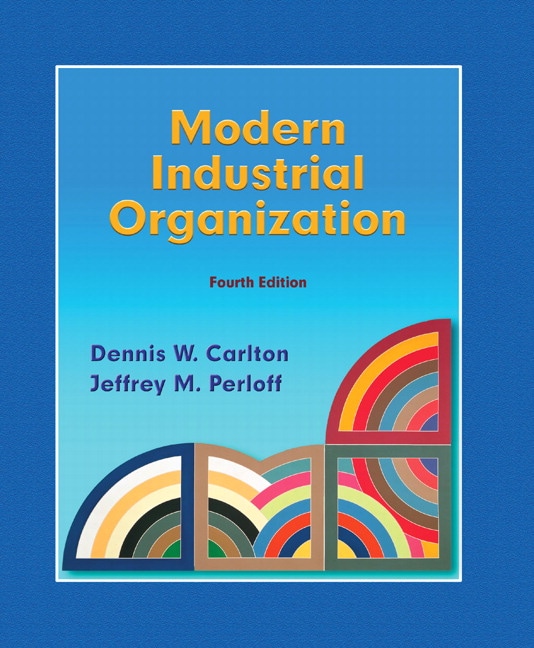

Carlton D. And Perloff Modern Industrial Organization Fourth Edition 2005 Edition
Dimensions
- 51 Oz
- 7.6in.
- 1.4in.
- 9.2in.
Additional Product Features
Carlton D. And Perloff Modern Industrial Organization Fourth Edition 2005 Download
- 22
- I. INTRODUCTION AND THEORY. 1. Overview. 2. The Firm and Costs. II. MARKET STRUCTURES. 3. Competition. 4. Monopolies, Monopsonies, and Dominant Firms. 5. Cartels. 6. Oligopoly. 7. Product Differentiation and Monopolistic Competition. 8. Industry Structure and Performance. III. BUSINESS PRACTICES: STRATEGIES AND CONDUCT. 9. Price Discrimination. 10. Advanced Topics in Pricing. 11. Strategic Behavior. 12. Vertical Integration and Vertical Restrictions. IV. INFORMATION, ADVERTISING, AND DISCLOSURE. 13. Information. 14. Advertising and Disclosure. V. DYNAMIC MODELS AND MARKET CLEARING. 15. Decision Making Over Time: Durability. 16. Patents and Technological Change. 17. How Markets Clear: Theory and Facts. VI. GOVERNMENT POLICIES AND THEIR EFFECTS. 18. International Trade. 19. Antitrust Laws and Policy. 20. Regulation and Deregulation., I. INTRODUCTION AND THEORY. 1. Overview. 2. The Firm and Costs. II. MARKET STRUCTURES. 3. Competition. 4. Monopolies, Monopsonies, and Dominant Firms. 5. Cartels. 6. Oligopoly. 7. Product Differentiation and Monopolistic Competition. 8. Industry Structure and Performance. III. BUSINESS PRACTICES: STRATEGIES AND CONDUCT. 9. Price Discrimination. 10. Advanced Topics in Pricing. 11. Strategic Behavior. 12. Vertical Integration and Vertical Restrictions. IV. INFORMATION, ADVERTISING, AND DISCLOSURE. 13. Information. 14. Advertising and Disclosure. V. DYNAMIC MODELS AND MARKET CLEARING. 15. Decision Making Over Time: Durability. 16. Patents and Technological Change. 17. How Markets Clear: Theory and Facts. VI. GOVERNMENT POLICIES AND THEIR EFFECTS. 18. International Trade. 19. Antitrust Laws and Policy. 20. Regulation and Deregulation.
- Yes
- 338.6
- 2005
- Dennis w. Carlton, Jeffrey M. Perloff
- 4
- 800 Pages
- Revised
- Hd2326.C376 2005
- 2004-05-13
- 2004-007014